
Nakshatra
Nakshatra is the term for Lunar mansion in Hindu astrology and Buddhist astrology.
A nakshatra is one of 27 sectors along the ecliptic.
Each Nakshatra has its particular power or Shakti; the powers of the stellar alignments and deities that rule over and define nakshatra yoking.
Each has an ascending and a descending energy.
↣ the power
▲ its basis above
▼ its basis below
➳ the result

In this catalogue:
Nakshatra and Shakta
Each nakshatra is listed in Sanskrit, listing for proper diacritical notation and Sanskrit-language text; each Shakta of each nakshatra is listed in Sanskrit, listing the etymology of the word with its tonal qualities.
The portion on Shakta offers arrows of direction revealing the energic motion, as you will see describing the transcending interrelationship of Shakta and describing the transmission result of Shakta.
Ruling Planet and Deity
The deities ruling over each nakshatra is also listed, listing the name of the deity with its qualities and characteristics, and listing the ruling planet or nakshatra Lord with its significant influence.
Pada and Purushartha
Every nakshatra is divided into four padas related to the Char Dham, a set of four pilgrimage sites in India. Listed are the padas as systematically aligned with the four purusharthas, or the fundamental aims of human existence. The four aims of life: Dharma, Artha, Kama, Moksha. These systematic alignments and parts of division reveal the underlying motivation behind a planet’s energy in that specific quarter.


Aśvinī
अश्विनी
shidhra vyapani shakti
↣ the power to reach things quickly
▲ the creatures to be healed
▼ the healing therapies
➳ the entire world becomes free from disease
0°-0'-0" to 13°-20'
deity
The Ashvinas, the heavenly twin brother gods who served as physicians to the gods and goddesses. Since depicted as celestial physicians, they are associated with healing, rejuvenation, and the restoration of balance. People born here have a strong urge to take initiative, to start things, and to act quickly. At the same time, because Ashwini Kumaras are healers, these people often help others in emergencies, medical issues, or sudden problems. They may not be patient planners, but they are the ones who come forward when quick action is needed.
ruling planet
Ketu
The presiding Lord of this lunar house is Ketu (South lunar node). Ketu is often associated with spiritual growth, past life karma, and the journey toward liberation, enhancing spiritual tendencies with a focus on detachment and karmic lessons.
Ketu Mantra
|| ॐ स्त्रां स्त्रीं स्त्रौं स केतवे नमः ||
Pada 1: Dharma (Purpose)

Bharaṇī
भरणी
apabharani shakti
↣ the power to take things away
▲ the removal of life from the body
▼ the carrying of the soul to the realm of the ancestors
➳ creatures move on to the next world
13°-20' to 26°-40'
deity
Yama
Yama is seen as a deity of death, dharma, the south direction, and the underworld who predominantly features in Hindu and Buddhist mythology, belonging to an early stratum of Rigvedic Hindu deities. Yama´s influence is deeply connected to the life cycle, emphasizing the connection to transformation, ethical boundaries, and the weight of karmic responsibility. Natives often show strong willpower, creativity, and the ability to carry burdens that others cannot. Because Yama is the presiding deity, Bharani deals with discipline, truth, and justice.
ruling planet
Venus (Shukra)
The presiding ruling planet of this lunar house is Venus. Venus is a harmonious planet associated with love, beauty, and values. That means those ruled may come to see beauty and fairness as virtues, and furthermore, see self-worth as a need for stability.
Shukra Mantra
|| ऊँ द्रां द्रीं द्रौं सः शुक्राय नमः ||
Pada 2: Artha (Wealth)

कृत्तिका
dahana shakti
↣ the power to burn (and to purify)
▲ heat
▼ light
➳ burning or purification
26°-40' to 10°-00'
corresponding to the open star cluster called Pleiades in western astronomy; it is one of the clusters which makes up the constellation Taurus
deity
Agni
Agni, in Hindu mythology, is the god of fire and light, symbolizing the vital spark of life and immortal energy. Within the Vedic tradition, you’ll find that rituals often involve fire as a conduit for offerings to the gods, exemplifying Agni’s vital place in both cosmic and mundane spheres. This deity encapsulates the nakshatra’s fiery essence, emphasizing qualities such as illumination and purification. Agni, the fire god, as Krittika´s deity, gives these natives a nature that is transformative, passionate, and sometimes harsh.
ruling planet
Sun (Surya)
When the Sun is your chart ruler, life takes on the flavor of vitality, radiance, and creativity. The Sun is the center of our solar system – the source of light and life. To have the Sun as your chart ruler is to be called into a life where identity, purpose, and self-expression are central.
Surya Mantra
|| ऊँ ह्रां ह्रीं ह्रौं सः सूर्याय नमः।|
Pada 3: Kama (Desire)


रोहिणी
rohana shakti
↣ its power is growth
▲ the plants
▼ the waters
➳ creation
10°-00' to 23°-20'
deity
Brahma
In astrology, Brahma is symbolically associated with the creative principle and innovative energy. As a symbol, he signifies beginnings and the tremendous potential for genesis in one’s life. When considering Brahma’s placement and influence in a horoscope, you realize his connection to the generosity and expansiveness found within the energy of creation.
ruling planet
Moon (Chandra)
When the Moon is your chart ruler, life takes on the flavor of feeling, intuition, and emotional rhythm. The Moon reflects light rather than generating it – it is receptive, reflective, and cyclical. To have the Moon as your chart ruler is to live life in tune with cycles, sensations, and tides of emotion. Your path is one of sensitivity and attunement. You are here to notice what others may overlook – the subtle shifts in energy, the needs beneath the surface, the wisdom that arises in silence. The Moon guides you toward nurturing, connection, and the deep intelligence of your emotional body.
Chandra Mantra
|| ॐ श्रां श्रीं श्रौं सः चंद्राय नमः ||
Pada 4: Moksha (Liberation)
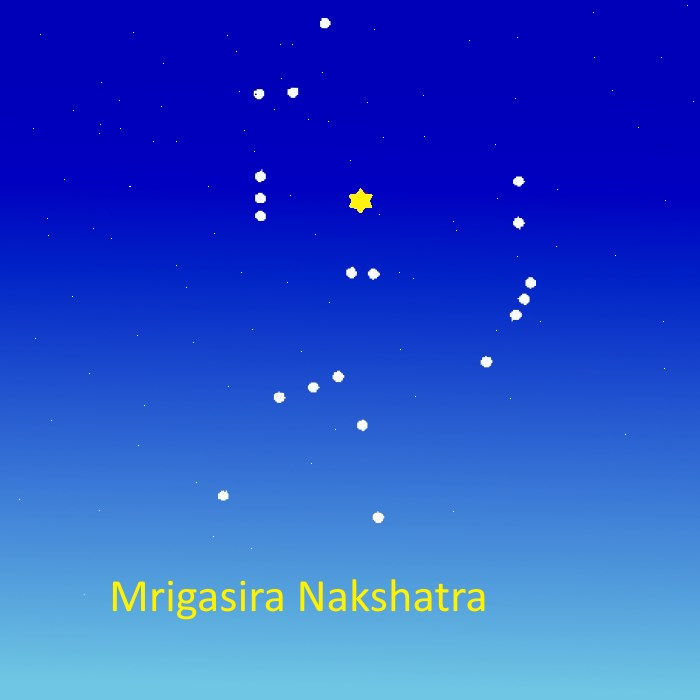
मृगशीर्ष
prinana shakti
↣ the power to reach things quickly
▲ extension
▼ weaving
➳ make our life more attractive
23°-20' to 06°-40'
deity
Chandra
Chandra, the Moon God, holds a revered place in Hindu mythology, astrology, and spiritual practices. Chandra embodies tranquility, emotional depth, and the nurturing aspects of divinity. Often depicted as a youthful and radiant deity riding a chariot pulled by ten white horses, Chandra’s celestial presence governs the mind, emotions, and creativity.
ruling planet
Mars
When Mars is your chart ruler, life takes on the flavor of action, drive, and courage. Mars is the planet of vitality, assertion, and desire – the part of us that acts, initiates, and pursues what it longs for. To have Mars guiding your chart is to be called into a life where passion and movement are central. Your path is one of initiation. Mars as ruler continually places you in situations where you must act, decide, and move forward. Through this rulership, you are asked to cultivate bravery, presence, and the ability to direct your life force toward meaningful aims.
Mangal Mantra
|| ॐ क्रां क्रीं क्रौं स भौमाय नमः ||
Pada 1: Dharma (Purpose)

आर्द्रा
yatha shakti
↣ its power is effort
▲ hunting or searching
▼ reaching the goal
➳ achievement
06°-40' to 20°-00'
deity
Rudra
Rudra (रुद्र) is the name of a deity whose icon is worshiped for the benefit of “knowledge”, as discussed in the twenty-eighth chapter of the Nāradīyasaṃhitā: a Pāñcarātra document. Rudra (रुद्र) is described in the Netratantra of Kṣemarāja: a Śaiva text from the 9th century in which Śiva (Bhairava) teaches Pārvatī topics such as metaphysics, cosmology, and soteriology (Wisdom Library), as fierce form of Śiva.
ruling planet
Rahu
Rahu, despite lacking a physical form, wields significant influence in astrology. It is often linked with ambition, illusion, and material success. Many view Rahu as a planet that drives worldly desires and unconventional thinking.
Rahu Mantra
|| ॐ भ्रां भ्रीं भ्रौं सः राहवे नमः ||
Pada 2: Artha (Wealth)


पुनर्वसु
vasutva prapana shakti
↣ the ability to gain wealth or substance
▲ wind or air
▼ wetness or rain
➳ revitalization of the plants
20°-00' to 03°-20'
deity
Aditya(s)
The twelve sons born to the sage Kaśyapa of his wife Aditi are known as the twelve Ādityas. They are the following: Dhātā, Mitra, Aryamā, Rudra, Varuṇa, Sūrya, Bhaga, Vivasvān, Pūṣā, Savitā, Tvaṣṭā and Viṣṇu. Besides these Aditi had twentyone children including Indra. All of them are called Ādityas meaning children of Aditi.
Āditya (आदित्य)
ruling planet
Jupiter
The planet Jupiter (Guru) is linked with wisdom, curiosity and spirituality. A strong Jupiter leads to wise, optimistic, and eager individuals. However, a weak alignment with Guru may lead to people feeling lost, which in turn can compel them to overdo things.
Brihaspati Mantra
|| ॐ ब्रिम बृहस्पतये नम: ||
Pada 3: Kama (Desire)

पुष्य
brahmavarchasa shakti
↣ its power is the ability to create spiritual energy
▲ sacrificial worship
▼ the healing therapies
➳ creation of spiritual energy
03°-20' to 16°-40'
deity
Brihaspathi
With Brihaspati (the divine teacher) as deity, Pushya emphasizes wisdom, guidance, and dharma.
ruling planet
Saturn (Shani)
A positive alignment of Shani or Saturn encompasses discipline, responsibility, and hard work, whereas an unfavorable position of the planet leads to people facing delays or feeling stuck. Shani Dev is the son of Surya and is associated with ambition and status as well as pessimism and hardships (Wisdom Library).
Shani Mantra
||ॐ प्राम प्रीम प्रोम सह शनैश्चराय नम: ||
Pada 4: Moksha (Liberation)


आश्लेषा
visasleshana shakti
↣ has the power to inflict with poison
▲ the approach of a serpent
▼ trembling and agitation
➳ brings about destruction of the victim
16°-40' to 30°-00'
deity
Nagas
Nāga (नाग) refers to one of the 53 gods to be worshipped in the northern quarter and given pāyasa (rice boiled in milk) according to the Vāstuyāga rite in Śaktism (cf. Śāradātilaka-tantra III-V). The worship of these 53 gods happens after assigning them to one of the 64 compartment while constructing a Balimaṇḍapa. Vāstu is the name of a prodigious demon, who was killed by 53 gods (e.g., Nāga). Nāga as a doorway deity is associated with the Nakṣatra called Svāti and the consequence is kandarpa. With Nagas as deities, Ashlesha natives deal with both wisdom and illusion.
ruling planet
Mercury
The position of Budh or Mercury decides how we communicate and how far we can foster our intellectual prowess. The strong placement of Mercury improves the rate at which we learn along with decision-making skills and a weak placement of the planet can hamper how we learn and our decision-making.
Budh Mantra
|| ॐ ब्रां ब्रीं ब्रौं सह बुद्धाय नमः ||
Pada 1: Dharma (Purpose)
Maghā
मघा
tyage kshepani shakti
↣ grants the favor of one's ancestors and the ability to commune with them inwardly
▲ mourning
▼ leaving the body
➳ bring about death
00°-00' to 13°-20'
deity
Pithas
With the Pitris (ancestors) as deities, Magha is deeply tied to ancestral blessings, lineage, and karmic duties.
ruling planet
Ketu
The presiding Lord of this lunar house is Ketu (South lunar node). Ketu is often associated with spiritual growth, past life karma, and the journey toward liberation, enhancing spiritual tendencies with a focus on detachment and karmic lessons.
Ketu Mantra
|| ॐ स्त्रां स्त्रीं स्त्रौं स केतवे नमः ||
Pada 2: Artha (Wealth)

पूर्व फाल्गुनी
prajanana shakti
↣ the power of procreation
▲ wife or feminine partner
▼ husband or masculine partner
➳ the creation of the fetus
13°-20' to 20°-40'
deity
Bhaga
One of the twelve Ādityas born as sons of Kaśyapa prajāpati by his wife, Aditi. Bhaga (भग) is the name of a deity, according to the Śivapurāṇa 2.2.37. Accordingly:—“[...] after uprooting his enemies, like a lion the elephants of the forest, Vīrabhadra surveyed all the quarters frequently to know ‘who is where’. [...] Nandin plucked out the eyes of Bhaga who was felled over the ground with anger because it was, he who winked at Dakṣa while cursing”. Bhaga, the deity of prosperity and marital bliss, blesses these natives with love for relationships, pleasure, and social life.
ruling planet
Venus
The presiding ruling planet of this lunar house is Venus. Venus is a harmonious planet associated with love, beauty, and values. That means those ruled may come to see beauty and fairness as virtues, and furthermore, see self-worth as a need for stability.
Shukra Mantra
|| ऊँ द्रां द्रीं द्रौं सः शुक्राय नमः ||
Pada 3: Kama (Desire)

उत्तर फाल्गुनी
chayani shakti
↣ its power is the giving of prosperity
▲ wealth gained from one's family
▼ wealth gained from one's partner
➳ the accumulation of wealth
20°-40' to 10°-00'
deity
Aryaman
Āryama (आर्यम) is associated with the constellation Uttaraphālguni, according to the Bṛhatsaṃhitā (chapter 6), an encyclopedic Sanskrit work written by Varāhamihira mainly focusing on the science of ancient Indian astronomy astronomy (Jyotiṣa).—Accordingly, “If Mars (bhauma) should re-appear in the constellation of Pūrvaphālguni (sacred to Bhāga) or in that of Uttaraphālguni (sacred to Āryama), retrograde in the constellation of Uttarāṣāḍha (sacred to Viśvedeva) and disappear in the constellation of Rohiṇī (sacred to Bhauma), he will afflict the three worlds with miseries” (Wisdom Library).
ruling planet
Sun (Surya)
When the Sun is your chart ruler, life takes on the flavor of vitality, radiance, and creativity. The Sun is the center of our solar system – the source of light and life. To have the Sun as your chart ruler is to be called into a life where identity, purpose, and self-expression are central.
Surya Mantra
|| ऊँ ह्रां ह्रीं ह्रौं सः सूर्याय नमः।|
Pada 4: Moksha (Liberation)


हस्त
hasta sthapaniya agama shakti
↣ its power is the ability to gain what we are seeking and place it in our own hands
▲ seeking of gain
▼ the process of gaining
➳ together place what one wishes to gain in one's own hands
10°-00' to 23°-20'
deity
Savitar
The deity Savitar blesses natives with creativity, intelligence, and optimism.
ruling planet
Moon (Chandra)
When the Moon is your chart ruler, life takes on the flavor of feeling, intuition, and emotional rhythm. The Moon reflects light rather than generating it – it is receptive, reflective, and cyclical. To have the Moon as your chart ruler is to live life in tune with cycles, sensations, and tides of emotion. Your path is one of sensitivity and attunement. You are here to notice what others may overlook – the subtle shifts in energy, the needs beneath the surface, the wisdom that arises in silence. The Moon guides you toward nurturing, connection, and the deep intelligence of your emotional body.
Chandra Mantra
|| ॐ श्रां श्रीं श्रौं सः चंद्राय नमः ||
Pada 1: Dharma (Purpose)
चित्रा
punya cayani shakti
↣ its power is the ability to accumulate merit in life
▲ the law
▼ the truth
➳ the worker is able to gain honor in one's own work
23°-20' to 06°-40'
deity
Vishwakarma
With Vishwakarma (the celestial architect) as deity, Chitra natives are skilled in creation, architecture, and innovation. It represents beauty, creativity, and the power to build or design.
ruling planet
Mars
When Mars is your chart ruler, life takes on the flavor of action, drive, and courage. Mars is the planet of vitality, assertion, and desire – the part of us that acts, initiates, and pursues what it longs for. To have Mars guiding your chart is to be called into a life where passion and movement are central. Your path is one of initiation. Mars as ruler continually places you in situations where you must act, decide, and move forward. Through this rulership, you are asked to cultivate bravery, presence, and the ability to direct your life force toward meaningful aims
Mangal Mantra
|| ॐ क्रां क्रीं क्रौं स भौमाय नमः ||
Pada 2: Artha (Wealth)


Swati
स्वाति
pradhvamsa shakti
↣ gives the power to scatter like the wind
▲ moving in various directions
▼ change of form
➳ transformation
06°-40' to 20°-00'
deity
Vaya
Vayu, the wind god, gives them adaptability, communication skills, and restlessness.
ruling planet
Rahu
Rahu, despite lacking a physical form, wields significant influence in astrology. It is often linked with ambition, illusion, and material success. Many view Rahu as a planet that drives worldly desires and unconventional thinking.
Rahu Mantra
|| ॐ भ्रां भ्रीं भ्रौं सः राहवे नमः ||
Pada 3: Kama (Desire)
Vishakha
विशाखा
vyapana shakti
↣ gives the power to achieve many and various fruits in life
▲ plowing or cultivation
▼ the harvest
➳ give us the fruit of the harvest
20°-00' to 03°-20'
deity
Indra Agni
Indrāgni (इन्द्राग्नि)—the fire produced from the contact of clouds; °धूमः (dhūmaḥ) frost, snow; °देवता (devatā) the 16th lunar mansion. Derivable forms: indrāgniḥ (इन्द्राग्निः).
Indrāgni is a Sanskrit compound consisting of the terms indra and agni (अग्नि). (Wisdom Library).
ruling planet
Jupiter
The planet Jupiter (Guru) is linked with wisdom, curiosity and spirituality. A strong Jupiter leads to wise, optimistic, and eager individuals. However, a weak alignment with Guru may lead to people feeling lost, which in turn can compel them to overdo things.
Brihaspati Mantra
|| ॐ ब्रिम बृहस्पतये नम: ||
Pada 4: Moksha (Liberation)


अनुराधा
radhana shakti
↣ give us the power of worship
▲ ascension
▼ descension
➳ honor and abundance is gained
03°-20' to 16°-40'
deity
Mitra
Mitra (मित्र) refers to one of the gods to be worshipped and given pāyasa (rice boiled in milk) according to the Vāstuyāga rite in Śaktism (cf. Śāradātilaka-tantra III-V). Vāstu is the name of a prodigious demon, who was killed by 53 gods (e.g., Mitra). The lotus, its symbol, shows growth even in difficult surroundings. Natives of this nakshatra are loyal, hardworking, and focused on building lasting bonds.
ruling planet
Saturn (Shani)
A positive alignment of Shani or Saturn encompasses discipline, responsibility, and hard work, whereas an unfavorable position of the planet leads to people facing delays or feeling stuck. Shani Dev is the son of Surya and is associated with ambition and status as well as pessimism and hardships.
Shani Mantra
||ॐ प्राम प्रीम प्रोम सह शनैश्चराय नम: ||
Pada 1: Dharma (Purpose)

ज्येष्ठा
arohana shakti
↣ has the power to rise, conquer and gain courage in battle
▲ attack
▼ defense
➳ one becomes a hero
16°-40' to 30°-00'
deity
Indra
The Hindu god of weather considered the king of the devas and svarga in Hinduism. He is associated with the sky, lightning, weather, thunder, storms, rains, river flows, and war. Indra is the most frequently mentioned deity in the Rigveda. He is celebrated for his powers based on his status as a god of order, and as the one who killed the great evil, an asura named Vritra, who obstructed human prosperity and happiness. Indra destroys Vritra and his "deceiving forces" and thereby brings rain and sunshine as the savior of humankind.
ruling planet
Mercury
The position of Budh or Mercury decides how we communicate and how far we can foster our intellectual prowess. The strong placement of Mercury improves the rate at which we learn along with decision-making skills and a weak placement of the planet can hamper how we learn and our decision-making.
Budh Mantra
|| ॐ ब्रां ब्रीं ब्रौं सह बुद्धाय नमः ||
Pada 2: Artha (Wealth)


मूल
barhana shakti
↣ the power to ruin or destroy
▲ breaking things apart
▼ crushing things
➳ one gains the power to destroy destruction
00°-00' to 13°-20'
deity
Nirrti
Nirṛti (निरृति) refers to one of the goddesses to be worshipped in the western quarter and given pāyasa (rice boiled in milk) according to the Vāstuyāga rite in Śaktism (cf. Śāradātilaka-tantra III-V). Guided by Nirriti (goddess of dissolution), Mula brings transformation, endings, and new beginnings. It makes natives seekers of truth, unafraid of change, and often drawn to spirituality or research with a desire to uproot falsehood.
ruling planet
Ketu
The presiding Lord of this lunar house is Ketu (South lunar node). Ketu is often associated with spiritual growth, past life karma, and the journey toward liberation, enhancing spiritual tendencies with a focus on detachment and karmic lessons.
Ketu Mantra
|| ॐ स्त्रां स्त्रीं स्त्रौं स केतवे नमः ||
Pada 3: Kama (Desire)
पूर्व आषाढा
varchograhana shakti
↣ its power is that of invigoration
▲ strength
▼ connection
➳ one gains lustre
13°-20' to 26°-40'
deity
Jal
Purva Ashadha nakshatra is also known as Jal Nakshatra for its characteristics. The 20th nakshatra, as per Vedic astrology, has Venus as its ruling planet and is a distributor of things and information. It is male in gender and Apas is the Hindu deity. The nakshatra has a fan as its symbol or its practice of fanning information around the world and is highly philosophical in nature. The nakshatra also has an elephant’s tusk and ivory as other symbols which represent inner beauty and wisdom, which are the latent and potential spiritual faculties.
ruing planet
Venus (Shukra)
The presiding ruling planet of this lunar house is Venus. Venus is a harmonious planet associated with love, beauty, and values. That means those ruled may come to see beauty and fairness as virtues, and furthermore, see self-worth as a need for stability.
Shukra Mantra
|| ऊँ द्रां द्रीं द्रौं सः शुक्राय नमः ||
Pada 4: Moksha (Liberation)


उत्तर आषाढा
apradhrisya shakti
↣ its power is to grant an unchallengeable victory
▲ the strength to win
▼ the goal that one can win
➳ one becomes the unchallenged winner
26°-40' to 10°-00'
deity
Vishvadeva(s)
The Vishvadevas, or sons of Lord Dharma, are a group of deities of considerable importance in the Vedic tradition, particularly in the Rig Veda and the Vishnu Purana. In the Rig Veda, nearly forty hymns are dedicated to the Vishvadevas, vowing them as protectors of living beings and extolling their role in upholding the balance of the universe. They are believed to bring rewards and prosperity to those who adhere to righteous conduct and moral principles.
ruling planet
Sun (Surya)
When the Sun is your chart ruler, life takes on the flavor of vitality, radiance, and creativity. The Sun is the center of our solar system – the source of light and life. To have the Sun as your chart ruler is to be called into a life where identity, purpose, and self-expression are central.
Surya Mantra
|| ऊँ ह्रां ह्रीं ह्रौं सः सूर्याय नमः।|
Pada 1: Dharma (Purpose)


Śravaṇa
श्रवण
samhanana shakti
↣ its power is that of connection
▲ seeking
▼ the paths
➳ the connection of all things together
10°-0' to 23°-00'
deity
Vishnu
He has undertaken ten avatars(incarnations), each to achieve a specific purpose, to avert a specific calamity facing either mankind or the Devas. There are more than ten incarnations attributed to him, but only ten of them are considered major. The list of such avatars varies a bit in different sources. For more about his incarnations, see 'Incarnations of Vishnu'.
ruling planet
Moon
When the Moon is your chart ruler, life takes on the flavor of feeling, intuition, and emotional rhythm. The Moon reflects light rather than generating it – it is receptive, reflective, and cyclical. To have the Moon as your chart ruler is to live life in tune with cycles, sensations, and tides of emotion. Your path is one of sensitivity and attunement. You are here to notice what others may overlook – the subtle shifts in energy, the needs beneath the surface, the wisdom that arises in silence. The Moon guides you toward nurturing, connection, and the deep intelligence of your emotional body.
Chandra Mantra
|| ॐ श्रां श्रीं श्रौं सः चंद्राय नमः ||
Pada 2: Artha (Wealth)
धनिष्ठा
khyapayitri shakti
↣ its power is to give abundance and fame
▲ birth
▼ prosperity
➳ give the power to bring people together
23°-20' to 06°-40'
deity
Ashtavasav
Guided by the Ashta Vasus (eight elemental deities representing abundance and stability), Dhanishta natives blend material success with social responsibility. They understand that true wealth lies not only in possessions but also in wisdom, generosity, and harmony.
ruling planet
Mars
When Mars is your chart ruler, life takes on the flavor of action, drive, and courage. Mars is the planet of vitality, assertion, and desire – the part of us that acts, initiates, and pursues what it longs for. To have Mars guiding your chart is to be called into a life where passion and movement are central. Your path is one of initiation. Mars as ruler continually places you in situations where you must act, decide, and move forward. Through this rulership, you are asked to cultivate bravery, presence, and the ability to direct your life force toward meaningful aims
Mangal Mantra
|| ॐ क्रां क्रीं क्रौं स भौमाय नमः ||
Pada 3: Kama (Desire)


Shatabhishak
शतभिषा
bheshaja shakti
↣ has the power of healing
▲ extension or pervasiveness over all
▼ the support of all
➳ make the world free of calamity
06°-40' to 20°-00'
deity
Varuna
In Vedic Hinduism, he is the regent of the western direction and personifies the mysterious law of the Gods. He presides over the relationship of humans with the Gods. He is the presiding deity of the invisible world and represents the inner reality of things, higher truth (Ṛta), and order in their transcendent aspects, beyond understanding. He is also the lord of the causal waters that surround the world.
Varuṇa (वरुण, “mysterious, hidden”)
ruling planet
Rahu
Rahu, despite lacking a physical form, wields significant influence in astrology. It is often linked with ambition, illusion, and material success. Many view Rahu as a planet that drives worldly desires and unconventional thinking.
Rahu Mantra
|| ॐ भ्रां भ्रीं भ्रौं सः राहवे नमः ||
Pada 4: Moksha (Liberation)

पूर्व भाद्रपद
yajamana udyamana shakti
↣ gives the fire to raise a spiritual person up in life
▲ the good of all
▼ what is good for the gods
➳ the entire world to be supported
20°-00' to 03°-20'
deity
Ajaikapat
Ajaikapad, as outlined in Dharmashastra, is a unique deity linked to sacrificial offerings in ceremonies. This single-footed entity is specifically associated with the lunar mansion known as Proshthapadas, highlighting its significance in rituals and celestial connections. Ajaikapad embodies a blend of divine representation and astrological relevance, making it an important figure in the context of Hindu ceremonial practices.
ruling planet
Jupiter
The planet Jupiter (Guru) is linked with wisdom, curiosity and spirituality. A strong Jupiter leads to wise, optimistic, and eager individuals. However, a weak alignment with Guru may lead to people feeling lost, which in turn can compel them to overdo things.
Brihaspati Mantra
|| ॐ ब्रिम बृहस्पतये नम: ||
Pada 1: Dharma (Purpose)

उत्तर भाद्रपद
varshodyamana shakti
↣ its power is the bringing of the rain
▲ the raining clouds
▼ growing of the plants
➳ the three worlds gain their stability
03°-20' to 16°-40'
deity
Ahirbudhanya
Ahirbudhnya, meaning "Serpent of the Depths," is a Vedic deity associated with hidden wisdom, cosmic waters, and transformation. He is the governing deity of Uttara Bhadrapada Nakshatra, which influences introspection and spiritual awakening. Ahirbudhnya is also considered a form of Rudra, linked to serpent energy and the cosmic forces of the deep oceans.
Sanskrit: अहिर्बुध्न्य, romanized: Ahirbudhnyasaṃhitā
ruling planet
Saturn (Shani)
A positive alignment of Shani or Saturn encompasses discipline, responsibility, and hard work, whereas an unfavorable position of the planet leads to people facing delays or feeling stuck. Shani Dev is the son of Surya and is associated with ambition and status as well as pessimism and hardships.
Shani Mantra
||ॐ प्राम प्रीम प्रोम सह शनैश्चराय नम: ||
Pada 2: Artha (Wealth)


रेवती
kshiradyapani shakti
↣ has the power of nourishment symbolized by milk
▲ the cows
▼ the calves
➳ the nourishment of the entire world
16°-40' to 30°-00'
deity
Pushan
Pushan is known for his role as a solar deity, providing nourishment, guidance, and prosperity. He is also recognized as a soul guide, helping departed souls reach their final destination safely. His influence is believed to bring light, wisdom, and happiness to those under his celestial influence.
Sanskrit: पूषन्, IAST: Pūṣan
ruling planet
Mercury (Budh)
The position of Budh or Mercury decides how we communicate and how far we can foster our intellectual prowess. The strong placement of Mercury improves the rate at which we learn along with decision-making skills and a weak placement of the planet can hamper how we learn and our decision-making.
Budh Mantra
|| ॐ ब्रां ब्रीं ब्रौं सह बुद्धाय नमः ||
Pada 3: Kama (Desire)
More to base in this catalogue:
Sanskrit Language
Each nakshatra is listed in Sanskrit, listing for proper diacritical notation and Sanskrit-language text; each Shakta of each nakshatra is listed in Sanskrit, listing the etymology of the word with its tonal qualities. The proper diacritical notation of the powers listed above could be found and included, while always working for improvements toward proper languaging.
The portion on Shakta offers arrows of direction revealing the energic motion, as you will see describing the transcending interrelationship of Shakta and describing the transmission result of Shakta. There could be more notation in this catalogue in relation to the roots and branches, as below than so above.
Degrees and Asterisms
The name of each nakshatra is related to a prominent star or asterisms in or near the respective sectors. The positional degrees of each nakshatra are listed, listing with latitude and longitude determined by the zodiac. Astrological points are a fundamental concept in astrology, measured within a 360-degree circle that represents the zodiac. Each of the 12 zodiac signs occupies 30 degrees, making it essential to understand how these degrees influence the interpretation of planetary positions and aspects in a birth chart. The latitude degree refers to the angular distance north and south of the equator (0° Aries and 0° Libra). The longitude degree is the angular distance east or west of the prime meridian (where each longitude corresponds to zodiac energy, baseline at 0° longitude). Each nakshatra occupies 12°-20', while corresponding to a region of one zodiac sign or sometimes at the overlap of two zodiac signs. In essence, a nakshatra simply is a constellation. There could be more to state from sacred texts that connect these specific asterisms.
The deities ruling over each nakshatra is also listed, listing the name of the deity with its qualities and characteristics, and listing the ruling planet or nakshatra Lord with its significant influence. There could be more stories to share from scripture that relate to certain experiences brought be these energies.
Divisions and Charts
Every nakshatra is divided into four padas related to the Char Dham, a set of four pilgrimage sites in India. Listed are the padas as systematically aligned with the four purusharthas, or the fundamental aims of human existence. The four aims of life: Dharma, Artha, Kama, Moksha. These systematic alignments and parts of division reveal the underlying motivation behind a planet’s energy in that specific quarter. Each of the four padas within a nakshatra corresponds to one of the 12 zodiac signs, starting with Meṣa (Aries) and proceeding in order. This division is not arbitrary. With 27 nakshatras each having four padas, we arrive at a total of 108 padas in the entire zodiac. This number, 108, is sacred in many Eastern traditions, representing the wholeness of cosmic existence. It is the number of beads on a mala for chanting mantras, signifying the completion of a spiritual cycle. In astrology, these 108 padas represent the complete spectrum of human potential and karmic expression. This catalogue could focus more on the potential and karmic specifics of each nakshatra.
Rasi (or D1) is the main birth chart, which is known as your natal chart. The true genius of the pada system lies in its direct link to the zodiac signs and, most importantly, the Navamsa (or D9) divisional chart. The Navamsa is considered the most crucial divisional chart after the main birth chart (Rasi or D1), as it reveals the soul’s inner promise, the nature of one’s marriage and partnerships, and the fruits of one’s karma in the second half of life. Each of the four Padas within a Nakshatra corresponds to one of the 12 zodiac signs, starting with Aries and proceeding in order. For example, the first Nakshatra, Ashwini, is located entirely within the sign of Aries. Its four Padas correspond to the Navamsa signs of Aries, Taurus, Gemini, and Cancer. The next Nakshatra, Bharani, continues the sequence with its Padas corresponding to Leo, Virgo, Libra, and Scorpio. This means that a planet’s position in a specific Pada in your birth chart (D1) determines its sign placement in your Navamsa chart (D9). This is the key that unlocks the D9 chart. A planet may be in Aries in the main chart, but its Pada placement could give it the underlying quality of a completely different sign—like Cancer—in the Navamsa, profoundly altering its manifestation in your life. One can always research these charts.

References and More Resources
Welcome to Wisdom Library
This is a place of knowledge and wisdom, but not of silence. Here you can find a large and ever expanding collection of Books, Articles, Essay's, Hymns and much more.
Wisdom Library; The portal for Hinduism, Sanskrit, Buddhism, Jainism, Mesopotamia etc...
The 27 Nakshatras
In Vedic astrology, the lunar mansions or Nakshatras divide the zodiac into 27 distinct segments. Each Nakshatra has a symbol, ruling planet, presiding deity, guna, gana, and an animal symbol, offering deep insight into personality and life path.
27 Nakshatras: Traits, Deities, Padas & Meanings
Navagraha: The Astrological & Cosmic Significance of Rudraksha
Rudraksha beads have always been essential to Hinduism and many other cultures. However, these beads also have an important link with planets and humans. This is why astrology is also an integral topic of discussion when discussing Rudraksha.
Navagraha: The Astrological & Cosmic Significance of Rudraksha
Gods and Goddesses Associated with Planets in Vedic Astrology
Vedic Astrology can be understood by examining the nature and characteristics of the planets or grahas. Understanding these associations offers insights into personal development and spiritual growth.
Gods and Goddesses Associated with Planets in Vedic Astrology
Nakshatra Prediction
Vedic Astrology texts state nakshatras as crucial in determining personal characteristics. By analyzing the nakshatra, an astrology expert can read out the characteristics, personality, traits, inclinations, and other dimensions of life.
27 Nakshatra Names & their Astrology Characteristics
Ishta Devata Calculator: Worship Your Chosen Deity
It analyses and tell a person which deity he/she should worship, according to their birth chart. Many of us don't understand the significance behind it or often have the question, "Who is my ishta devata? How and why should I worship this deity?".
Ishta Devata Calculator: How to Know Your Chosen Deity
A Famous Vedic Astrologer in India
Astro Anuradha, a renowned Vedic Astrologer and Tarot Coach in India, has been guiding her students in the field for over 22 years. With expertise in Nadi Nakshatra, Praveena Level 1 & 2, and advanced astrology courses at the Visharada and Post Visharada levels from ICAS, she has honed her deep understanding of celestial influences. She has also trained under Shri A.V. Sundaram in Nadi Classes Level 1 and 2.