

Steps 1 – 4: Opening Sequence
Step 1: Tadasana [Mountain Pose]
Stand with your feet together, body aligned with your breath. Bring your palms to the namaskar position, stretch your hands over your head, and lengthen the spine. Stay in this position and take a few breaths before moving on to the next asana.
Step 2: Chandrasana [Side Stretch Pose]
Inhale deeply, and as you exhale, bend to the left side. Enjoy the gentle stretch you’ll feel on the right side. Be careful not to lean forward or backward, just to the side.
Step 3: Utkata Konasana [Victory Squat]
Return to the center, separate your feet, and turn them slightly outward. Inhale, and as you exhale, bend your knees, bringing your thighs parallel to the floor. Keep your forearms at 90 degrees with your arms and palms facing you. This is also called Goddess Pose, but that shouldn’t discourage men from trying it. It Helps strengthen the back and thighs.
Step 4: Utthita Tadasana [Five-Pointed Star]
For this, simply rise from the squatting position and stretch your elbows. Hands parallel to the floor. Relax the shoulders and chest.
--
Steps 5 – 8: Left-Side Flow
Step 5: Trikonasana: [Triangle Pose]
Step out with your left foot and slide to the left side. Extend your right hand upwards. This helps improve spinal flexibility and correct shoulder misalignment.
Step 6: Parsvottanasana: [Head-to-Knee Pose]
Now, bring your head down to touch the left knee. Rest both hands on your left foot. This asana helps improve posture and balance. It also aids digestion and stretches the muscles at the back of the leg.
Step 7: Left Side Lunge
Bend both knees and lunge to the left side. Keep your gaze to the left.
Step 8: Forward Lunge
Straighten your right knee and step into a forward lunge. Place both hands in front of you on the floor.
--
Steps 9 – 12: Center Flow and Right Side
Step 9: Malasana
Squat down with your feet firmly on the ground and palms together in front of you. Maintaining balance with your feet on the ground and your spine extended can be a bit challenging for some. This pose is often mistakenly referred to as the 'garland pose.' 'Mal' in Sanskrit means impurity. Since the regular practice of this asana helps improve bowel movement, that’s where the name comes from. However, some people incorrectly pronounce it as 'Maalasana,' and since 'maala' refers to a garland, confusion arises. That is the incorrect translation of the name.
Step 10: Forward Lunge
Now take a forward lunge, just as you did in step 8, but bend the right knee and extend the left. Keep your palms on the ground.
Step 11: Right Side Lunge
Take a lunge to the right side, keeping your gaze towards the right.
Step 12: Parsvottanasana [Head-to-Knee Pose]
Stretch both legs and bring your head to rest on the right knee, with both hands near the right foot.
--
Steps 13 – 17: Complete the sequence
Step 13: Trikonasana
Step into the triangle pose.
Step 14: Utthita Tadasana [Five-Pointed Star]
Straighten your knees and elbows.
Step 15: Utkata Konasana [Goddess Squat]
Return to the center, separate your feet, and turn them slightly outward. Inhale and as you exhale, bend your knees, bringing your thighs parallel to the floor. Keep your forearms at a 90-degree angle to your arms with your palms facing you. This is also called the Goddess Pose, but that shouldn’t stop men from trying it. It helps strengthen the back and thighs.
Step 16: Tiryaka Tadasana
Hands in namaskara position, extended above the head, lean to your right side.
Step 17: Tadasana
End a sequence by returning to the starting point: hands in namaskara position and extended above the head.

Chandra Mantra Chant Practice
A Chant practice is only effective if it’s done the right way. To gain maximum moon mantra benefits, consider the instructions given below.
-
Timing: The Moon is associated with the nighttime and Monday. So chanting the mantra during the evening or night on Mondays can be particularly favourable.
-
Place: Find a clean and quiet space to meditate on the Moon Mantra in order to avoid any disturbance in the process.
-
Meditation Mala: To maintain the right count of mantra repetition, it is advised to use a Mala or rosary bead while meditating. This especially helps when counting the Moon mantra 108 times.
-
Right Intention and Regularity: Lastly, regular practice, combined with a positive intention, can help you connect with the energy of the Moon and experience its potential benefits.
-
The Gyan Mudra: Maintain a hand gesture called the Gyan Mudra while meditating on the Chandra Mantra. Here, the index finger and thumb touch each other, forming a circle.
Significance of Chandra Mantra
The Chandra Arghya mantra holds great significance in astrology, specific to pleasing the Moon and bringing associated benefits like emotional stability, intuition, self-awareness and great skin. Since ancient times, it is considered an effective remedy to enhance our mind's capacity to nurture and heal.
Furthermore, it is believed that chanting the Chandra Mantra during the Lunar eclipse can help relieve its negative effects. Similarly, any Chandra dosha, weak Moon and Purnimas can be turned into an event of luck and prosperity. The Moon mantra is believed to keep away evil influences and protect people from harm.

-
Chandra Beej Mantra
The Moon Beej mantra is a sacred chant dedicated to Lord Chandra (the Moon) in Hinduism. The mantra attracts the energy and blessings of the Moon, which is associated with emotions, intuition, nourishment, and feminine energy. Chant either of them on the night of Full Moon 18 X 108 times facing Northwest direction.
-
|| ॐ सों सोमाय नम: ||
Om Som Somaya Nama -
|| ॐ श्रां श्रीं श्रौं सः चन्द्रमसे नमः ||
Om Shram Shreem Shraum Sah Chandramasay Namah
Meaning: Om, I bow to the Moon. May its energy bring peace, wisdom, and harmony into my life.
Benefits: Chanting the Chandra Beej mantra for prosperity, abundance, and satisfaction in life. It enhances emotional healing, increases self-confidence, soothes mental distress, and improves concentration.
-
Chandra Dhyan Mantra
The Chandra Dhyan mantra is a simple and powerful mantra believed to be effective in pleasing Lord Chandra, the moon deity. Chant the Chandra Dhyan Mantra below every Monday of a bright fortnight (Shukla Paksha), 18 X 108 times, facing the Chandra Yantra.
।। श्वेतांबरः श्वेता विभूषणस्चा श्वेता धुयातिर दंडाधारो द्विबाहुहु चंद्रो मृत्युत्मा वरदः किरीती माई प्रसादम् विधातु देव:।।
Shvetambharah Shveta Vibhushanascha Shveta Dhuyatir Dandadharo Dvibahuhu Chandro Mrutatma Varadhah Kireeti Mayi Prasadam Vidhdhatu Devah
Meaning: May the divine Lord, who is dressed in white, carries a staff, has two arms, a moon-like face, and is the giver of blessings, shower His grace upon me.
Benefits: As the moon governs emotions, chanting this mantra balances the flow of emotions. Seeking the grace of Lord Chandra promotes anger management and expressing the right reaction at the right time.
-
Chandra Gayatri Mantra
The Chandra Gayatri mantra is a powerful chant dedicated to the deity Chandra, who represents the Moon. For maximum Chandra Gayatri mantra benefits, chant it on a Monday of the Shukla Paksha either 3, 7, 9, 108, or 1008 times, facing East. It is as follows.
|| ॐ पद्मद्वाजय विधमहे हेमा रूपया धीमेहे तन्नो चंद्र प्रचोदयत ||
Om Padmadwajaya Vidhmahe Hema roopaya Dheemahe Tanno Chandra Prachodayat.
Meaning: Om, we meditate on the one who represents the lotus (symbolising purity), who has a golden form. May the Moon inspire and enlighten our minds.
Benefits: Chanting the Chandra Gayatri mantra benefits mental clarity, focus, and concentration. It can be helpful for students, professionals, or anyone seeking to improve their thinking abilities, creativity and intuition.
-
Chandra Navagraha Mantra
Chandra, or the Moon Navgraha Shanti mantra, is yet another way to strengthen the Moon in Kundli and seek planet Moon’s blessings. For maximum benefits, recite this Chandra mantra on the night of the Full Moon (Purnima) 54 or 108 times, facing Northwest.
|| दधिशंखतुषाराभं क्षीरोदार्णव सम्भवम नमामि शशिनं सोमं शम्भोर्मुकुटभूषणम् ||
Dadhishangkhatushaarabham Ksheerodaarnvasambhavam
Namaami Shashinam Somam Shambho Mukut Bhooshanam
Meaning: I bow to the Moon, who has the radiance of milk, shankh, and snow, who is born from the ocean of milk, the divine Soma, and the ornament on Lord Shiva's crown.
Benefits: Chanting the Chandra Navagraha Mantra helps balance the moon’s energy in our lives. This Moon mantra benefits our mental state, bringing peace and clarity to our minds. Devotees have seen enhanced luck and better control over emotions.
-
Chandra Namasakar Mantra
These are a bunch of powerful Chandra mantra for beauty, great skin, long-term youthfulness and a healthy body and mind. For maximum Moon mantra benefits from this type, chant the below Chandra Namaskar mantras every evening 4-5 times at once in the Northwest direction.
-
ॐ कामेश्वरयै नमः।
Om Kameshvaryai Namaha
Meaning: Salutations to one who fulfils desires. -
ॐ भागमलिन्यै नमः।
Om Bhagamalinyai Namaha
Meaning: Salutations to one who wears the garland of prosperity -
ॐ नित्यक्लिन्नयै नमः।
Om Nityaklinnayai Namahaa
Meaning: Salutations to one who is ever compassionate. -
ॐ भेरुणदयै नमः।
Om Bherundayai Namah
Meaning: Salutations to one who is fierce. -
ॐ वाहनिवासिनयै नमः।
Om Vahnivasinyai Namaha
Meaning: Salutations to one who lives in fire. -
ॐ वज्रेश्वरयै नमः।
Om Vajreshvaryai Namaha
Meaning: Salutations to one who possesses vajra, the thunderbolt -
ॐ दुतै नमः।
Om Dutyai Namaha
Meaning: Salutations to one whose messenger is Shiva. -
ॐ त्वरितायै नमः।
Om Tvaritayai Namaha
Meaning: Salutations to one who is swift. -
ॐ कुलसुमदरयै नम:।
Om Kulasumdaryai Namaha
Meaning: Salutations to one who is virtuous, respectable and charming. -
ॐ नित्यै नमः।
Om Nityayai Namaha
Meaning: Salutations to one who is eternal. -
ॐ नीलापटकिनयै नम:।
Om Nilapatakinyai Namaha
Meaning: Salutations to one who is adorned with a blue flag. -
ॐ विजयायै नमः।
Om Vijayayai Namaha
Meaning: Salutations to one who is ever victorious -
ॐ सर्वमंगलयै नमः।
Om Sarvamangalayai Namaha
Meaning: Salutations to one who is the source of all good fortunes. -
ॐ ज्वालामलिन्यै नमः।
Om Jvalamalinyai Namaha
Meaning: Salutations to one who is fenced with instant flames.
Overall Benefits: Chanting all the Namaskar Moon mantra benefits a person with immense inner beauty and a younger-looking appearance on the outside. It pleases the ever-glowing Moon deity, who, in turn, blesses their devotees with good health, radiant skin, self-confidence, creativity, and intellect.
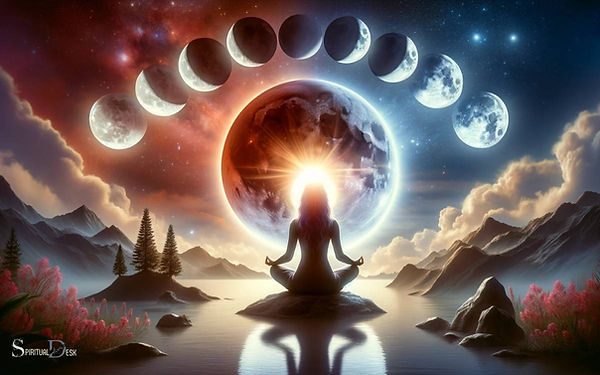
Moon meditation refers to meditative practices that align with the lunar cycle, particularly focusing on the energy of the moon during its various phases.
Benefits of Full Moon Meditation
-
Emotional Release: The full moon is associated with letting go of what no longer serves you. This meditation can help release emotional burdens and promote healing.
-
Increased Intuition: Many practitioners report heightened intuition and awareness during the full moon, making it a powerful time for self-discovery.
-
Clarity and Focus: The energy of the full moon can enhance mental clarity, allowing for deeper insights and understanding of personal challenges.
-
Connection to Nature: Engaging in moon meditation fosters a deeper connection to nature and the rhythms of the universe, promoting a sense of peace and grounding.
Additional Tips
-
Regular Practice: Incorporating moon meditation into your monthly routine can deepen your connection to the lunar cycles and enhance your meditation practice over time.

what does it mean to reflect on the moon...
upon every single subconscious motif...
with consideration of a Mandala?
May we cognize through a scope
meeting within the energy of Chandra
seeing the make-up of a refraction point
Worshipping this point as deity, to see the way a prism offers a microcosmic scope into a number of areas of interest within one's spirit quest.


mandala, in Hindu and Buddhist Tantrism, a symbolic diagram used in the performance of sacred rites and as an instrument of meditation. The mandala is basically a representation of the universe, a consecrated area that serves as a receptacle for the gods and as a collection point of universal forces. Man (the microcosm), by mentally “entering” the mandala and “proceeding” toward its centre, is by analogy guided through the cosmic processes of disintegration and reintegration.
Mandalas in are basically of two types, representing different aspects of the universe: the garbha-dhatu (Sanskrit: “womb world”; Japanese taizō-kai), in which the movement is from the one to the many; and the vajra-dhatu (Sanskrit: “diamond [or thunderbolt] world”; Japanese kongō-kai), from the many into one.
The mandala of a Tibetan tanka (cloth scroll painting) characteristically consists of an outer enclosure around one or more concentric circles, which in turn surround a square transversed by lines from the centre to the four corners. In the centre and the middle of each triangle are five circles containing symbols or images of divinities, most commonly the five “self-born” buddhas. Of the borders surrounding the mandala, the first is a ring of fire, which both bars entry to the uninitiated and symbolizes the burning of ignorance; next comes a girdle of diamonds, which stands for illumination; then a circle of eight graveyards, symbolizing the eight aspects of individuating cognition; next a girdle of lotus leaves, signifying spiritual rebirth; and, finally, at the centre, the mandala itself, where the images are set.
Similar ritual drawings have been found in cultures other than Hindu and Buddhist—for example, in the sand paintings of the North American Indians. The Swiss psychologist Carl Jung published studies of mandala-like drawings executed by his patients. In his view, the spontaneous production of a mandala is a step in the individuation process—a central concept in Jung’s psychological theory—and represents an attempt by the conscious self to integrate hitherto unconscious material.


This statue of the Hindu moon god Chandra is made from andesite and comes from the island of Java in what is now Indonesia. It dates from the late-9th to early-10th century CE. (Museum Rietberg, Zürich)
By saṃyama,1 on the moon, comes knowledge of
the stars’ arrangement.


1. saṃyama: process of psychological absorption into the object of meditation, combining simultaneous practice of dhāraṇā, dhyāna and samādhi
In Vedic astrology, the zodiac is divided into twelve Rāśis, each corresponding to a segment of the celestial sphere and associated with specific characteristics and planetary influences.

Nakshatra is the term for Lunar mansion in Hindu astrology and Buddhist astrology. A nakshatra is one of 27 sectors along the ecliptic. Their names are related to a prominent star or asterisms in or near the respective sectors. In essence, a nakshatra simply is a constellation. Every nakshatra is divided into four padas related to the Char Dham, a set of four pilgrimage sites in India.
